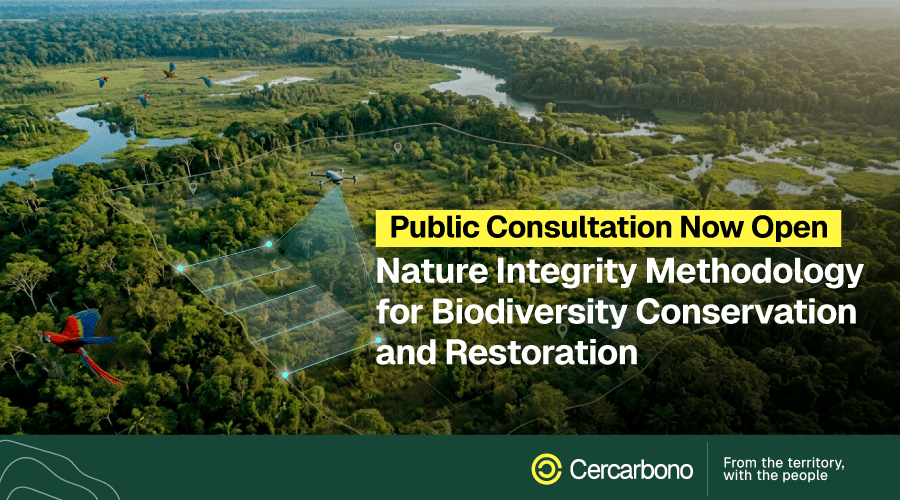
Cercarbono has opened a 30 day public consultation on the Nature Integrity Methodology for Biodiversity Conservation and Restoration (Version 1.1), the technical methodology behind its Biodiversity Certification Programme (CBCP). The consultation runs from 11 September to 11 October 2026, and Cercarbono invites communities, project developers, academia, environmental authorities and civil society to review the document and share comments before it is finalised.
The methodology was developed together with Biodiversity Intelligence, and gives Cercarbono a standardised, science based way to measure ecosystem condition and change over time. At its centre is the Ecosystem Condition Score (ECS), a score that combines the biological composition and physical structure of an ecosystem, assessed against a documented reference condition. The ECS is designed to be practical and repeatable across ecosystem types, combining remote sensing with strategic fieldwork so that large areas can be monitored at a reasonable cost.
The methodology covers two project pathways. Biodiversity Conservation Projects (BCP) protect ecosystems that already hold demonstrable biodiversity value and face a credible risk of deterioration, with the goal of maintaining that condition over time. Biodiversity Restoration Projects (BRP) work in degraded ecosystems, with the goal of moving them toward an approved reference condition. A conservation project sustains an existing condition and a restoration project delivers a measurable gain, so the two pathways generate separate, non-fungible classes of Voluntary Biodiversity Credits (VBC), each calculated on its own terms.
This distinction also shapes how additionality is demonstrated. A BCP must show the documented threat that its protection and stewardship activities address. A BRP must show that the degradation it addresses would otherwise persist, and its credits are calculated from the verified improvement in the Ecosystem Condition Score against that baseline.
Version 1.1 also strengthens the methodology’s governance provisions. Where a project sits on land under collective, customary or Indigenous tenure, the Project Management Plan must document how affected rights holders and local communities participate meaningfully in project governance, disclose the project’s decision making and accountability structure, and set out benefit sharing arrangements that are fair, equitable, co-designed with those communities, and reviewed at every verification.
The Nature Integrity Methodology is designed to support the objectives of the Convention on Biological Diversity and the Kunming-Montreal Global Biodiversity Framework. Certified projects run for a minimum operational lifespan of 40 years, with an initial 10 year accreditation period that can be renewed.
Public comment is a standard, required step before a new Cercarbono methodology is finalised. All comments received will be reviewed and, where relevant, incorporated before the methodology is submitted for approval. Stakeholders can review the full methodology document and submit comments through Cercarbono’s website until 11 October 2026.